
Why Getting Your Roll Off Tarp Replacement Right Matters
How to replace tarp on roll off truck is a question every fleet operator faces sooner or later — and getting it wrong can mean load spills, compliance fines, or costly downtime.
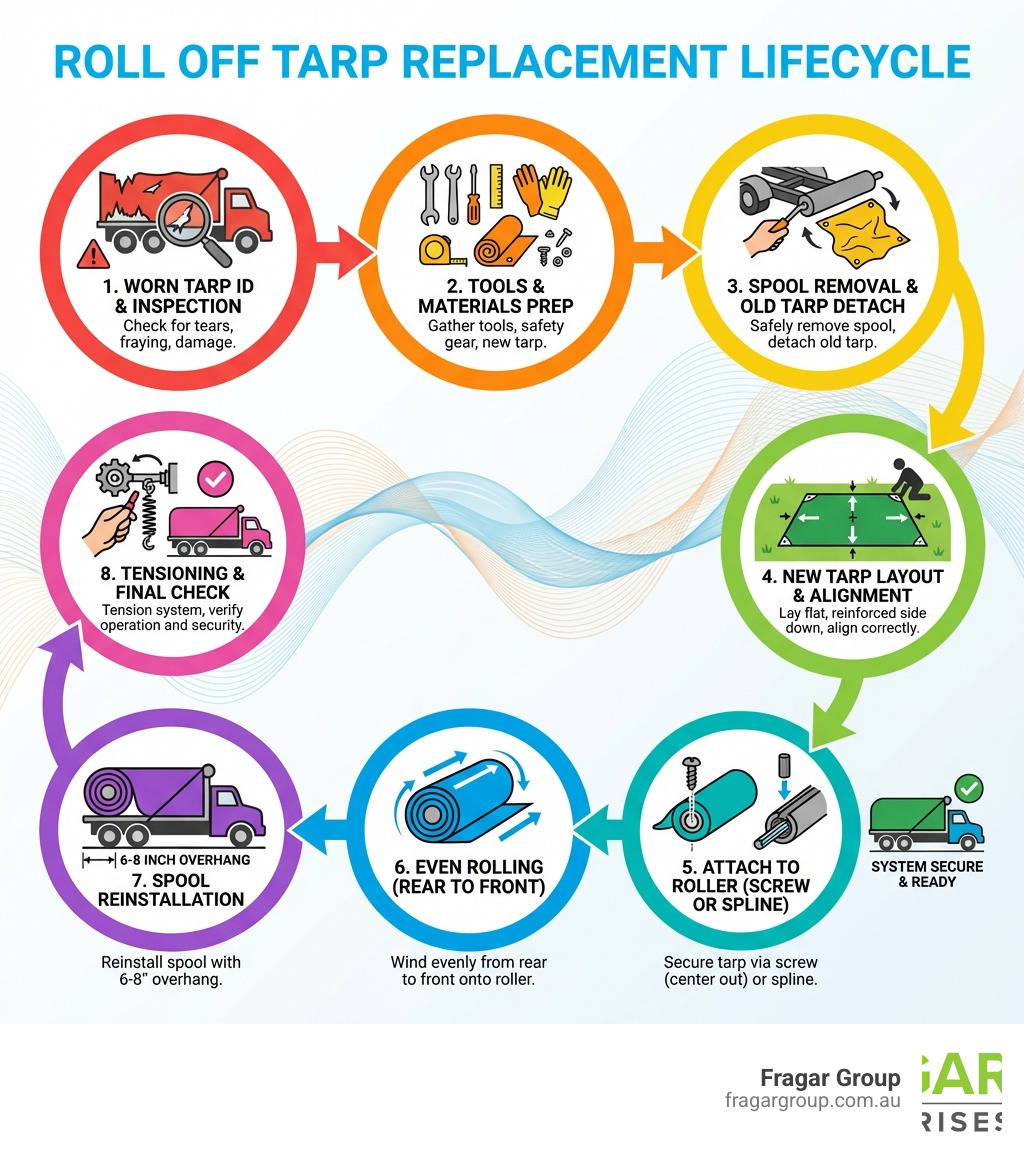
Here’s a quick overview of the process:
- Remove the tarp spool and detach the old tarp from the roller
- Lay the new tarp out flat on the ground, reinforced side down
- Attach the tarp to the roller using either the screw method (center outward) or the spline method
- Roll the tarp evenly onto the roller from rear to front
- Reinstall the spool, allowing 6-8 inches to hang below the base rest
- Wind and tension the spool per your manufacturer’s instructions
It typically takes a few hours with the right tools and experience. Larger or more complex systems can take longer.
Tarps do more than keep your load tidy. In most Australian states, driving with an unsecured or uncovered load is illegal — and enforcement is real. A worn or failing tarp isn’t just a maintenance headache. It’s a liability.
The challenge is that roll off tarp systems aren’t all the same. Fixed gantry, telescoping gantry, single-axle, multi-axle — each system has its own quirks. And every manufacturer has its own specific installation approach.
That means a generic replacement job done without the right knowledge can cause more problems than it solves.
Whether you’re doing this yourself or managing a crew, this guide walks you through exactly what’s involved — from pulling the old tarp off safely to tensioning the new one correctly.
Preparation: Tools and Choosing the Right Replacement Tarp
Before we get our hands dirty, we need to make sure we aren’t bringing a knife to a gunfight. Proper preparation is the difference between a two-hour job and a two-day ordeal. At Fragar Group, we’ve seen plenty of “quick fixes” turn into long-term nightmares because of poor planning.
Getting the Measurements Right
You can’t just eyeball a roll off tarp. If it’s too narrow, debris flies out the sides; if it’s too long, it won’t tension correctly on the spool. We recommend using Measure Sheets to record the exact width of your roller tube and the length of your longest container. A good rule of thumb is to choose a tarp length at least 2–3 feet (approx. 60–90cm) longer than the truck body or container to ensure full coverage even with peaked loads.
Material Selection: Mesh vs. Vinyl
Choosing the right material depends entirely on what you’re hauling.
- Mesh Tarps: These are the workhorses for general waste, construction debris, and landscaping materials. They allow air to flow through, reducing “wind whip,” but they aren’t waterproof.
- Vinyl Tarps: If you’re hauling “hot top” asphalt or materials that must stay dry, 18 oz heavy-duty vinyl is your best friend. It’s heavier and more wind-resistant but requires more motor torque to move.
| Feature | Mesh Tarp | Vinyl Tarp (18 oz) |
|---|---|---|
| Durability | High (Resistance to tears) | Very High (Waterproof & UV) |
| Best For | Sand, Gravel, Rubbish | Asphalt, Grain, Sensitive Loads |
| Weight | Lightweight | Heavy |
| Breathability | High (Reduces flapping) | None |
Your Essential Tool List
Don’t start the how to replace tarp on roll off truck process without these in your kit:
- Sawzall (Reciprocating Saw): Essential for cutting through corroded pins or seized bolts.
- Impact Wrench & Drill: For removing mounting brackets and driving new self-tapping screws.
- Ladders or Work Platform: Safety first! Never balance on the edge of a greasy bin.
- Tape Measure: To ensure the tarp is perfectly centered.
- All-purpose Lubricant: To treat joints and bearings while the system is apart.

Step-by-Step Guide on How to Replace Tarp on Roll Off Truck
Now for the heavy lifting. Whether you have a manual pull-style or a sophisticated Power Tarp System, the core mechanics of replacement remain similar.
Step 1: Tension Release and Spool Removal
Safety is paramount here. If your system uses a spring-loaded roller, you must “pin” the roller or remove the tension before detaching the tarp. For automatic systems, ensure the electric motor is switched off at the breaker.
- Fully extend the tarp to expose the roller tube.
- Secure the spool rod (some use a 3/8″ bolt in the groove to prevent it from spinning).
- Carefully remove the tarp spool from its mounting brackets. This often requires two people or a mechanical lift.
Step 2: Removing the Old Tarp
Once the spool is down, slide the old tarp out of the groove. If it’s a screw-attached system, back out the fasteners. This is the perfect time for a “mid-job” inspection. Check the roller tube for cracks or bends. If a loader has dropped a heavy rock on your tube, it might be crushed—if so, replace the tube now, or your new tarp will never roll straight.
Step 3: Cleaning and Lubrication
While the tarp is off, clean the roller tube and gantry area. Use a wire brush to remove rust and apply a generous coating of lubricant to the bearings and pivot points. This simple step can add years to the life of your motor and arms.
Attaching the New Tarp: Screw Method vs. Spline Method
There are two primary ways the tarp grips the roller.
The Screw Method: Lay the new tarp flat on the ground, reinforced side down. Place the roller assembly at the rear of the tarp. Align the center grommet of the tarp with the center of the roller tube. Drive your first screw (with a wide washer) into the center. Work your way outward to the edges, keeping the material taut. This prevents the “bunched-up” look that leads to uneven rolling.
The Spline Method: Many modern systems use a “C-channel” groove. The tarp will have a plastic or rubber “spline” sewn into the top edge. Simply slide the spline into the groove from one end. It’s faster, but you must ensure the tarp is perfectly centered before you lock it in place.
How to Replace Tarp on Roll Off Truck: Reinstalling the Spool
With the tarp attached, roll it onto the roller tube evenly. Ensure the side flaps are tucked correctly (usually on the bottom as it rolls).
- Lift the assembly back into the mounting brackets.
- The 6-8 Inch Rule: When the tarp is fully retracted, allow 6-8 inches (15-20cm) of material to hang below the base rest. This provides a “buffer” so the tension isn’t pulling directly on the fasteners when the truck is bouncing down the highway.
- If you have a Rollover Tarp System, double-check the gantry alignment. If the gantry is skewed, the tarp will track to one side and eventually tear.
Safety Precautions and Tensioning for Longevity
We’ve seen enough “snap-backs” to know that tarp springs are no joke. They store a massive amount of energy.
General Safety Guidelines
- Power Lines: Never operate or replace a tarp system under overhead power lines.
- Battery Disconnect: If you’re working on an electric system, disconnect the battery. A motor that accidentally kicks in while your fingers are in the spool is a recipe for disaster.
- Circuit Protection: Ensure your 6-gauge wiring is protected by a circuit breaker (usually 50-60 amps).
Maintaining Proper Tension in Your How to Replace Tarp on Roll Off Truck Project
The secret to a long-lasting tarp is even tension. Most roll off systems use torsion springs at the base of the arms.
- Replace in Pairs: If one spring is worn or broken, replace all the springs on that side (usually 3 to 5 per side). Using one new spring with four old ones creates uneven pressure, causing the arms to twist.
- Arm Synchronization: Ensure the pivot points are lubricated so the arms move at the exact same speed. If one arm lags, the tarp will wrinkle, leading to “wind whip” damage.
- Landing Legs: If your system uses a Landing Leg System, ensure the legs are level and the mounting pins are greased to prevent binding during the extension phase.
Common Mistakes to Avoid During Installation
Even the pros can trip up. Here are the most common pitfalls we see in the field:
- The “Wrinkle” Effect: If you don’t start fastening from the center and work outward, you’ll get diagonal wrinkles. These wrinkles act like sandpaper every time the tarp rolls up, wearing through the material in weeks.
- Improper Wire Routing: When wiring electric motors, leave enough “play” at the pivot points. If the wire is too tight, it will snap when the gantry moves; if it’s too loose, it’ll get pinched in the machinery.
- Reusing Corroded Pins: It’s tempting to put that old rusty pin back in to save five minutes. Don’t. Corroded pins seize up, making the next replacement a nightmare involving a Sawzall and a lot of swearing. Use new pins and coat them in silicone or grease.
- Ignoring the Motor Direction: After installing an electric system, check the rotation. The tarp must roll over the axle, not under it. If it spins the wrong way, simply swap the two wires on the motor terminals.
- Over-tightening: Don’t crank the fasteners so hard that you crush the grommets. Use wide washers to spread the load.
Frequently Asked Questions about Roll Off Tarp Replacement
How often should I replace my roll off tarp?
There is no “magic number” because it depends on your load. However, we recommend a thorough inspection every month. Look for UV fading (which makes the fabric brittle), frayed edges, and thinning material over the bows. If you can see daylight through the fabric or if the grommets are pulling out, it’s time. Most heavy-use tarps in the Australian sun last 1–2 years before needing replacement.
Can I repair a small tear instead of replacing the whole tarp?
Yes, but only if the tear is small (under 30cm) and not near a high-tension area like the spool attachment. You can use a heat-weld patch or a vinyl repair kit. For mesh tarps, sewing is often better. However, if the structural integrity is compromised—especially on a high-speed Power Tarp System—replacement is safer to avoid a roadside failure.
How long does a typical tarp replacement take?
For a seasoned technician with the right tools, it takes about 2–3 hours. If you’re doing it for the first time as a DIY project, budget 5–8 hours. The biggest time-wasters are usually seized bolts and improper measurements, so prep work is key!
Conclusion: Don’t Roll the Dice on Quality
Replacing a tarp might seem like a simple maintenance task, but it’s the frontline of your truck’s safety and compliance. A poorly installed tarp leads to flapping, tearing, and eventually, a load of debris on the M4.
At Fragar Group, we pride ourselves on being pioneers in the Australian tipper industry. We know that if your truck isn’t moving, you aren’t making money.
Whether you need a new heavy-duty vinyl tarp for your roll off container or a complete system overhaul, we’ve got you covered with Australian-made quality that stands up to our tough conditions.
Ready to get your fleet back in peak condition? View our full product range in the Fragar Group Catalogue
Need a tarp for your truck?
Pull-out tipper tarp kits: cut to your box width and delivered Australia-wide, from $1,199 inc GST. Order online
Retractable tarp systems: mesh or PVC, hand wind or electric, made to measure. Request a quote
Questions? Call 1300 850 413 (7am–5pm Mon–Fri) or email sales@fragargroup.com.au.


