
Why Investing in Quality Australian Truck Tarps is Essential for 2026
Quality Australian truck tarps are purpose-built to handle the country’s brutal conditions — intense UV, heavy rain, and high winds — while keeping loads secure and operators compliant.
Top quality Australian truck tarps at a glance:
- Retractable tarps – Best for tipper trucks; fast to operate, no climbing required
- Rollover tarps – Ideal for side-to-side load coverage; weatherproof sealing
- Pull-out tarps – Lightweight option for smaller commercial vehicles
- Mesh tarps – High airflow for loads like gravel and rubble
- PVC tarps – Full weatherproofing for grain, waste, and moisture-sensitive loads
Key features to look for:
- 900gsm+ PVC fabric (1800gsm in high-wear zones)
- UV stabilisation and fire-retardant materials
- Reinforced stitching and edges
- EPA compliance for load containment
- Australian-made construction suited to local conditions
If you run a tipper fleet, you already know the problem. Loads shift. Tarps fail. Compliance fines add up. And every minute a driver spends wrestling with a manual tarp is a medium off the road.
Australia’s climate makes this even harder. Extreme UV degrades cheap materials fast. Strong winds turn a poorly secured tarp into a road hazard. And heavy rain can ruin sensitive cargo if your cover isn’t up to the job.
The good news? The Australian market has some of the most advanced tarping systems in the world — built specifically for these conditions, and increasingly automated so your drivers never have to climb a 4-metre truck again.
This guide covers the best options available in 2026, what to look for, and how to choose the right system for your fleet.
When we talk about quality australian truck tarps, we aren’t just talking about a piece of fabric thrown over a bin. We are talking about an engineered system designed to survive the Pilbara’s heat, the Blue Mountains’ storms, and the constant vibration of NSW highways. In 2026, the stakes for load containment have never been higher, with stricter EPA regulations and a growing focus on workplace health and safety (WHS).
The Australian climate is a “tarp killer.” Standard off-the-shelf imports often lack the UV stabilisation required to prevent the fabric from becoming brittle and cracking after just one summer. High-quality systems use 900gsm PVC as a baseline. To put that in perspective, many “heavy-duty” retail tarps are barely half that weight. For high-wear areas—where the tarp rubs against the top rail of a tipper or the edges of a bin—we often see reinforcements of up to 1800gsm. This quad-layer approach ensures that even under constant friction, the tarp remains tear-proof.
Beyond the fabric, the hardware matters. Wind resistance is a major factor; a tarp that flaps at 100km/h isn’t just noisy—it’s a sail that increases fuel consumption and eventually shreds itself. Quality systems are designed with aerodynamic tensioning to stay flat and secure. This isn’t just about protecting the cargo; it’s about EPA compliance. If debris, dust, or “road spray” escapes your trailer in NSW, the fines can be staggering. Investing in a professional system ensures 100% containment while adhering to the National Transport Commission (NTC) Load Restraint Guide, keeping the authorities happy and your balance sheet healthy.
Comparing Retractable and Rollover Tarping Systems
Choosing the right mechanical system is the first step toward a more efficient fleet. In the Australian transport industry, two heavyweights dominate the market: the Rollover Tarp System and the retractable (front-to-back) system.

Rollover Tarp Systems
A rollover system operates side-to-side. It is the gold standard for loads that need to stay dry, such as grain, fertiliser, or moisture-sensitive waste. Because the tarp rolls over a center ridge pole and seals tightly against the side rails, it offers superior weatherproofing. These systems are incredibly durable; some high-quality Australian builds have been known to last up to 15 years when used seasonally and stored correctly.
Retractable Tarping Systems
Retractable systems, often called “wind-out hood tarps” or “front-to-back” systems, are the workhorses of the construction and quarrying industries. They use a dual-cable system to pull the tarp from the headboard to the tailgate. The primary advantage here is speed. A driver can cover a load of gravel or rubble in seconds. Because these systems often sit inside the headboard when retracted, they provide the driver with total rear vision during loading—a massive safety win.
Comparison Table: Retractable vs. Rollover
| Feature | Retractable (Front-to-Back) | Rollover (Side-to-Side) |
|---|---|---|
| Primary Use | Tippers, Rubbish, Quarry | Grain, Bulk Haulage, Waste |
| Weather Sealing | Good (Containment focused) | Excellent (Waterproof focus) |
| Operation Speed | Very Fast | Fast |
| Weight | Often <40kg fitted | Varies by trailer length |
| Loading Access | Full top access | Clear side/top access |
| Compliance | EPA Load Containment | EPA & Full Weather Shield |
Selecting the Right Quality Australian Truck Tarps for Your Load
Not all loads are created equal, and neither are the tarps that cover them. If you are hauling scrap steel or jagged demolition waste, a standard PVC tarp might meet its match. In these cases, we often recommend heavy-duty mesh. Mesh allows for high airflow, reducing the “ballooning” effect, and is incredibly resistant to punctures from sharp metal.
For those in the grain or bulk haulage sector, PVC is non-negotiable. You need a 100% waterproof seal to protect the value of your cargo. When selecting your tarp, consider the following:
- Tippers & Trailers: Usually require retractable systems for frequent loading/unloading.
- Walking Floors: Often benefit from rollover systems due to the length of the trailer.
- Hook Lifts & Skip Bins: May require specialised “undercover” or “double cover” systems to manage varying bin heights.
To ensure a perfect fit, we always recommend using Measure Sheets before ordering. A tarp that is even 100mm too short can lead to gaps that compromise load security. Custom dimensions are the only way to guarantee that “factory fit” look and performance.
The Shift to Automated and Electric Tarping Solutions
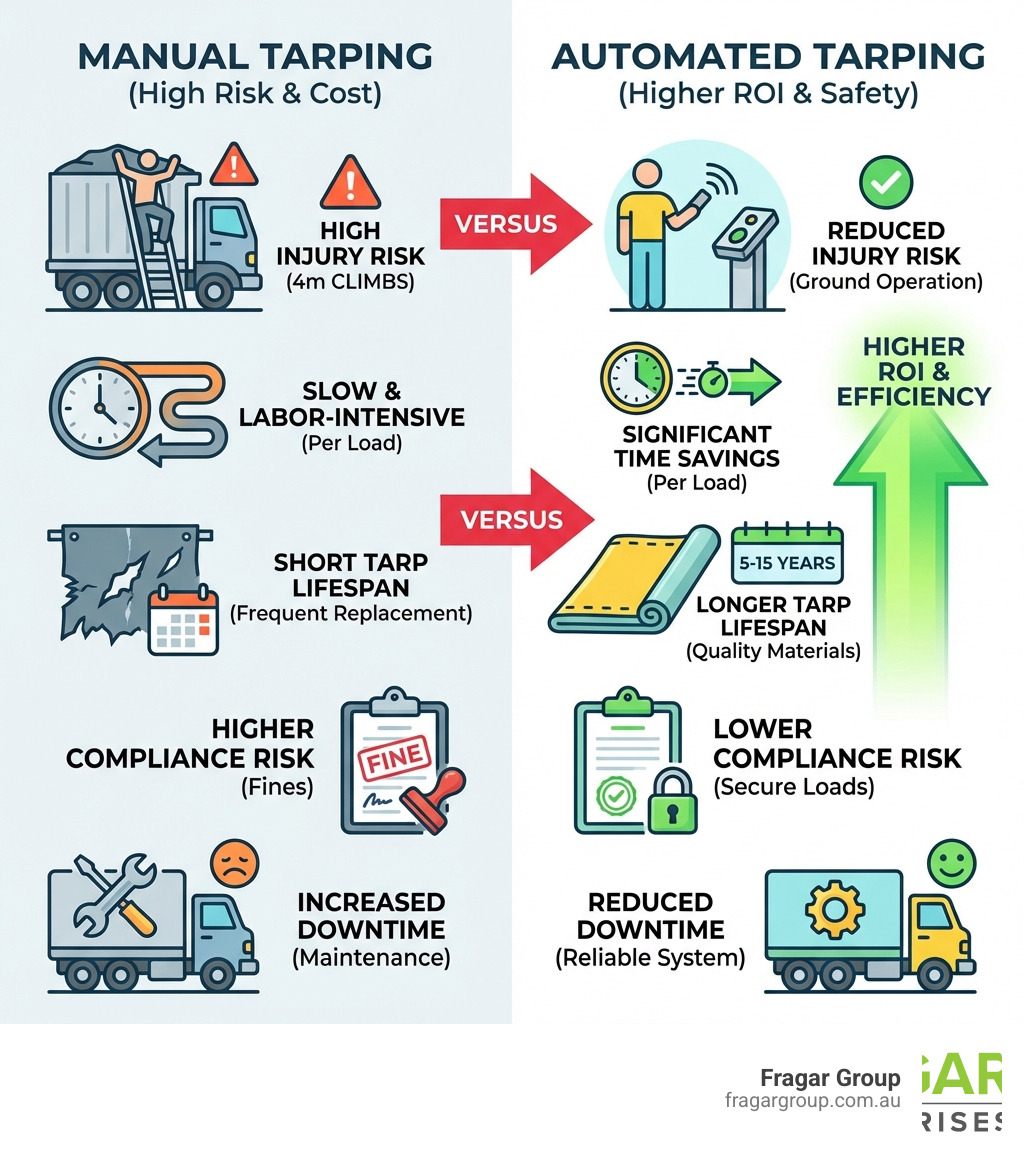
The days of a driver “surfing” a load 4 metres in the air to tie down ropes are, thankfully, coming to an end. Safety is the biggest driver of innovation in quality australian truck tarps for 2026. With trucks reaching heights of 4 metres, the risk of a fall is a significant liability for any transport business.
An automated Power Tarp System allows the operator to cover and uncover the load from the safety of the cab or the ground via remote control. This doesn’t just prevent injuries; it skyrockets efficiency. If a truck does 10 loads a day and saves 5 minutes per tarping cycle, that’s nearly an hour of extra “wheels turning” time every single day.
Modern Automated tarping technology now features high-torque electric motors, which are built to handle the resistance of a heavy PVC tarp even in high winds. Many of these electric systems also include a manual override.
Maximising the Lifespan of Your Commercial Tarp
A high-quality Australian tarp is an investment, and like any investment, it needs a little “TLC” to reach its full potential. While a cheap tarp might last a season, a premium 900gsm PVC tarp can realistically last 5 years in a 24/7 demanding environment (like mining or constant quarry work) and up to 15 years in seasonal applications.
Here is how we recommend maximising that lifespan:
- Tension is Key: A loose tarp flaps. Flapping leads to “wind whip,” which fatigues the fabric and the stitching. Keep your cables and springs tensioned according to the manufacturer’s specs.
- UV Protection: When the truck is parked up for the off-season, store it undercover if possible. While our tarps are UV-stabilised, 365 days of direct Australian sun will eventually take its toll.
- Clean the Tracks: For retractable systems, ensure the side rails or cables are free of debris. Sand and grit act like sandpaper on your tarp edges.
- Repair Early: If you see a small nick from a piece of scrap metal, patch it immediately. A 2cm tear can become a 2-metre tear very quickly under wind pressure.
Professional branding is another benefit of going custom. Many operators choose to have their company logo printed directly onto the PVC. Because quality tarps use high-grade inks and coatings, your “rolling billboard” stays looking professional for years, rather than fading into an unreadable mess within six months.
Where to Source Quality Australian Truck Tarps Nationwide
Finding a supplier that understands the specific needs of NSW transport is vital. Whether you are based in Sydney, Condobolin, or anywhere across the state, you need more than just a product—you need support.
At Fragar Group, we focus on the tipper truck industry with a commitment to local manufacturing standards. This means parts are always available. There is nothing worse than having a $200,000 rig sidelined because a $50 plastic clip from an imported tarp system broke and you can’t find a replacement.
We understand that downtime is lost revenue, so we manufacture our systems and parts here in Australia, minimising the time your truck spends off the road. You can browse our full range of components and systems in our Catalogue to see the level of heavy-duty engineering that goes into every build.
Frequently Asked Questions about Truck Tarps
How long do quality Australian truck tarps last?
Lifespan depends heavily on usage and material. A premium 900gsm PVC tarp used on a grain trailer (seasonal) can last up to 15 years if stored in a shed when not in use. For trucks running 24/7 in harsh environments like the Pilbara or heavy construction sites, a lifespan of 5 years is the industry benchmark for a high-quality Australian-made product.
What is the difference between mesh and PVC tarps for load containment?
Mesh is designed for load containment where waterproofing isn’t necessary—think gravel, sand, or green waste. It’s lightweight and handles wind well. PVC is for “all-weather” protection. It is heavier, waterproof, and essential for loads like grain, fertiliser, or general freight that must stay dry.
Are electric tarp systems safer than manual manual tarping?
Absolutely. Electric systems eliminate the need for drivers to climb onto the truck or trailer. Given that trucks can be up to 4 metres high, eliminating this climb significantly reduces the risk of falls and workplace injuries. Furthermore, ground-level manual overrides mean the driver stays safe even if the power fails.
Built for the Long Haul
In the demanding world of Australian transport, your equipment is only as strong as its weakest link. Don’t let that link be a sub-par tarp. Whether you are hauling grain across the plains or moving rubble through the streets of Sydney, quality australian truck tarps provide the durability, safety, and compliance you need to stay profitable in 2026.
With over 12 years of expertise as pioneers in the industry, we pride ourselves on delivering systems that stand up to the test of time.
Ready to upgrade your load security? Secure your load with a retractable tarp system or explore our automated options today.
Need a tarp for your truck?
Pull-out tipper tarp kits: cut to your box width and delivered Australia-wide, from $1,199 inc GST. Order online
Retractable tarp systems: mesh or PVC, hand wind or electric, made to measure. Request a quote
Questions? Call 1300 850 413 (7am–5pm Mon–Fri) or email sales@fragargroup.com.au.


